
Sustainability reports, GHG inventories, ESIAs — and the underlying data architecture that makes them defensible. Aligned to GRI, IFRS S1/S2, ESRS, and BRSR. Designed so an assurance provider can review the evidence without rebuilding it first.
Audit-ready sustainability reporting under GRI, IFRS S1/S2 and ESRS, plus GHG inventories, for GCC companies preparing for mandatory disclosure on ADX, DFM and Tadawul.
Three reporting services
Each engagement designed so the assurance provider on the other side doesn't have to refactor the data architecture before signing.
-
01 Sustainability reports
Full-cycle delivery — materiality refresh, data collection design, narrative development, stakeholder review, design coordination — for GRI, IFRS S1/S2, ESRS, BRSR, or hybrid structures.
-
02 GHG inventory (Scopes 1, 2, 3)
Boundary-setting, source mapping, calculation engine build (with audit trail), Scope 3 screening, base-year alignment, recalculation methodology — all under GHG Protocol & ISO 14064-1.
-
03 ESIA & scoping
Environmental and social impact assessment for capital projects, infrastructure, and industrial expansion — IFC PS, EBRD PR, World Bank ESF aligned.
Six structural problems we fix early
-
01 Boundary creep
The reporting boundary does not match the consolidation boundary in the financial statements, which is a common route to an assurance qualification.
-
02 No calculation reproducibility
Numbers in the report can't be recreated from source data without going back to the original analyst.
-
03 Mixed methodologies in the same KPI
Year-on-year comparisons that do not compare like-for-like, which makes trend reporting unreliable.
-
04 Estimated data without disclosure
Estimation flagged by assurance review, treated as misstatement when not transparently disclosed.
-
05 Source documents that can't be retrieved
Email-based data submission from operating units with no central repository.
-
06 Materiality drift
Reported topics don't match the materiality assessment that underlies them.
Reporting is a 12-month cycle, not a four-month sprint. We design the data architecture, the working-paper structure, and the assurance-readiness check at the start of the year — so the four-month sprint becomes a controlled production phase, not a fire-fight.
ESGweise One — built for this work
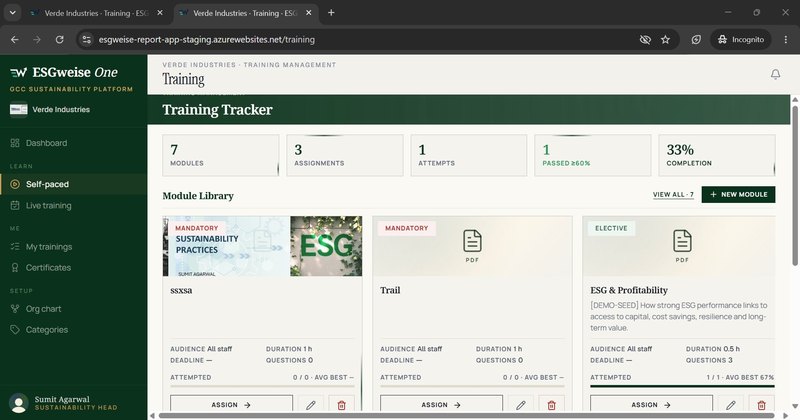
Our reporting engagements are backed by ESGweise One — a platform we built and run in production with GCC clients. Data collection, KPI dashboards, report builder, materiality assessment, and audit readiness in one place.
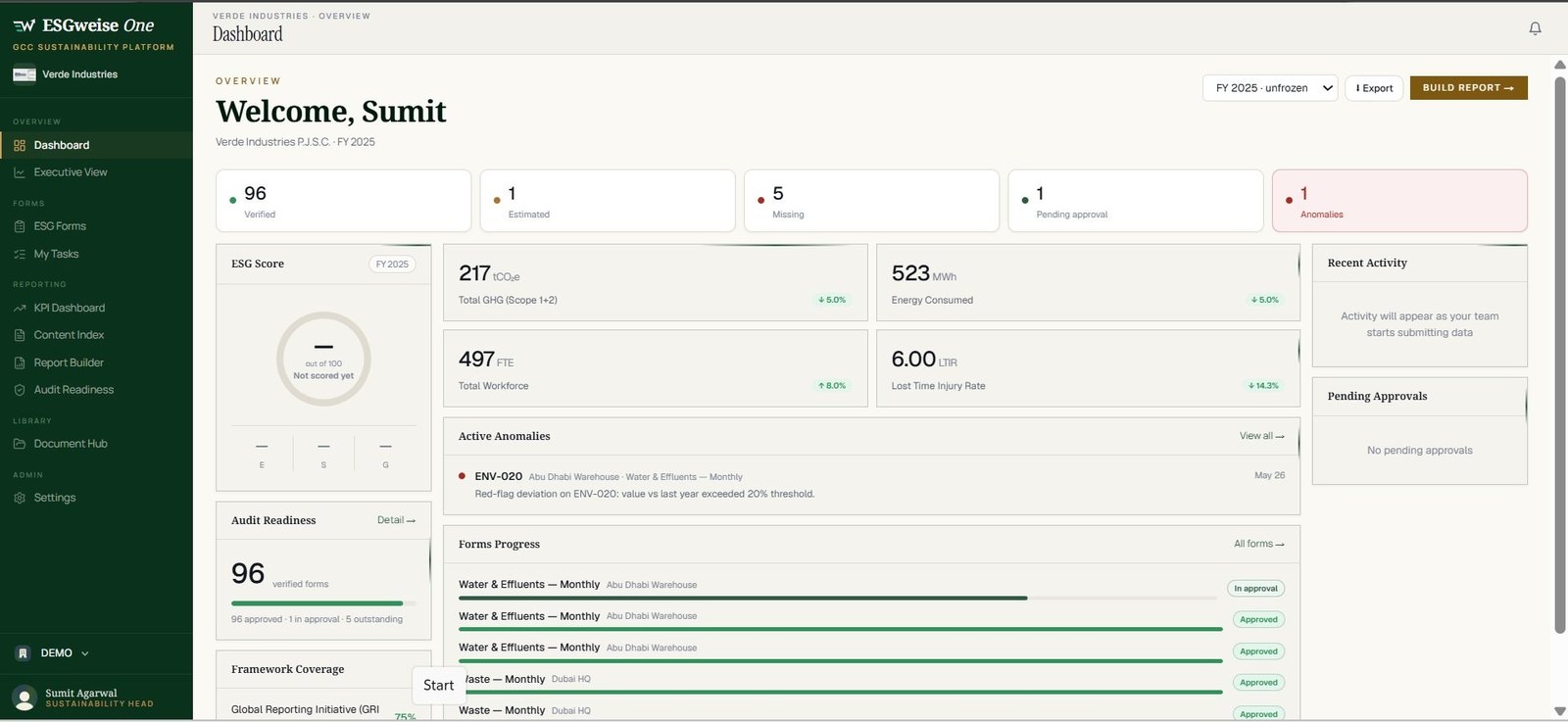 Dashboard · GHG & KPI overview
 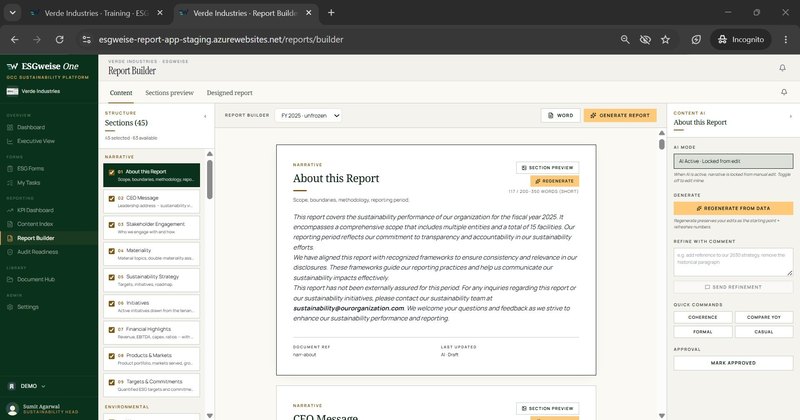 Report Builder · AI-assisted
  Materiality · Double flow
 UAE mandatory emissions reporting
Reporting in the UAE is now a legal obligation with a federal platform behind it. Primary-source analysis of what to file, where, and by when.
Reporting — questions we hear most
Is ESG reporting mandatory in the UAE?
Reporting is increasingly mandatory rather than voluntary. The UAE Climate Change Law (Federal Decree-Law 11 of 2024) introduces emissions reporting obligations for designated entities, with full compliance expected by around 30 May 2026, and emissions are filed through the national MRV platform. Listed companies also face ESG disclosure expectations from ADX and DFM. ESGweise produces reports aligned to these obligations and to GRI, IFRS S1/S2, and ESRS.
What is the difference between ESG reporting and sustainability reporting?
In practice the two terms are used interchangeably and describe the same disclosure. Sustainability reporting is the older, broader label for how an organisation reports its environmental and social performance, while ESG reporting frames the same information around the Environmental, Social, and Governance factors that investors and raters assess — so it tends to carry a sharper governance and capital-markets emphasis. A GRI, IFRS S1/S2, or ESRS report satisfies both descriptions. ESGweise scopes one report that serves regulators, investors, and rating agencies at once rather than producing separate documents.
Which sustainability reporting framework should we use — GRI, IFRS S1/S2, or ESRS?
It depends on your audience and obligations: GRI suits broad multi-stakeholder reporting, IFRS S1/S2 is the investor-focused global baseline, ESRS applies if you fall under EU CSRD reporting, and BRSR is relevant for Indian-listed group entities. Many GCC institutions adopt a hybrid structure to satisfy several audiences at once. ESGweise scopes the right framework mix during the materiality refresh so your report serves regulators and investors alike.
What makes a sustainability report audit-ready?
An audit-ready report has a reporting boundary that matches the financial consolidation boundary, calculations that can be reproduced from source data, consistent methodologies across years, and transparently disclosed estimates with retrievable source documents. We design the data architecture, working papers and assurance-readiness checks up front, so the evidence can be reviewed without being rebuilt first. This is the structural work that reduces the risk of a qualification.
How long does sustainability reporting take?
Done properly, reporting is a 12-month cycle, not a four-month sprint. ESGweise sets up the data architecture, working-paper structure, and assurance-readiness check at the start of the year, which turns the final reporting window into a controlled production phase rather than a year-end fire-fight. Full-cycle delivery covers materiality refresh, data collection design, narrative development, stakeholder review, and design coordination.
What is a GHG inventory and is it part of reporting?
A GHG inventory quantifies an organisation's Scope 1, 2, and 3 emissions under the GHG Protocol and ISO 14064-1, including boundary-setting, source mapping, a calculation engine with an audit trail, Scope 3 screening, and base-year alignment. It is a core input to most sustainability reports and to mandatory UAE emissions filings. ESGweise builds the inventory so it stands up to independent verification later.
Is ESG reporting mandatory in Saudi Arabia?
Saudi Arabia's regime is currently guidance-led rather than fully mandated. The Saudi Exchange (Tadawul) issued ESG Disclosure Guidelines so listed companies can report on a comply-or-explain basis aligned with global standards, while the Saudi Green Initiative and Vision 2030 set national net-zero-by-2060 and decarbonisation goals that increasingly shape investor and lender expectations. For large issuers and PIF-linked entities, ESG disclosure is fast becoming a practical requirement. ESGweise produces reports aligned to the Saudi Exchange guidelines and to GRI, IFRS S1/S2, and ESRS.
Is ESG reporting mandatory in Qatar?
Qatar's framework is largely guidance-based today. The Qatar Stock Exchange (QSE) publishes ESG reporting guidance for listed companies, the Qatar Financial Markets Authority (QFMA) oversees governance and disclosure, and the Qatar Financial Centre (QFC) has its own sustainability framework — all reinforced by Qatar National Vision 2030. Disclosure expectations are tightening as regional exchanges converge on IFRS S1/S2. ESGweise helps Qatari listed companies, QFC entities, and government-related groups build reports aligned to QSE guidance and to the global frameworks investors expect.
Thirty minutes. We figure out if there's a fit.
We don't pitch on the call. We listen, ask sharp questions, and tell you honestly whether reporting is what you need — or what else might be.
Speak with our team