A practical introduction to Scope 3 emissions, value-chain categories, emerging disclosure requirements and the business case for measuring indirect emissions.
Deciphering Scope 3 emissions can be a challenge for many, yet it’s a critical step towards effective corporate climate change strategies.
Traditionally, companies have considered emissions from their own operations (Scope 1 and Scope 2 of the GHG Protocol). However, there’s growing recognition of Scope 3 emissions, which encompass indirect sources beyond a company’s immediate control. This article aims to simplify and clarify Scope 3 emissions reporting, essential for developing comprehensive corporate climate strategies.
What falls under Scope 3
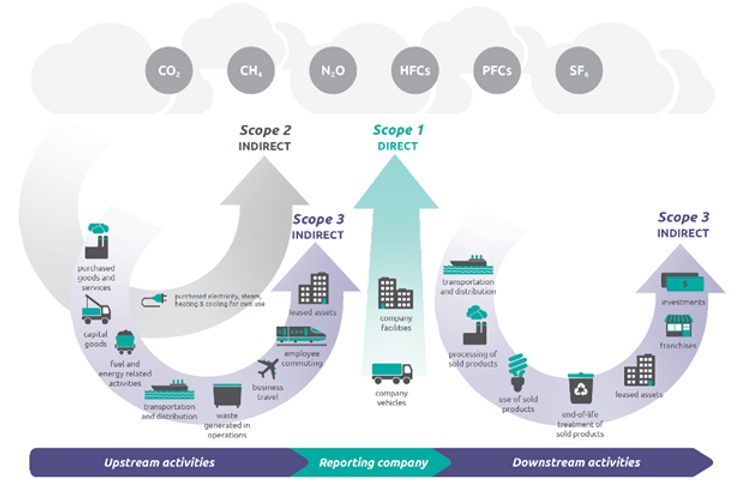
Scope 3 emissions occur from sources owned or controlled by other entities in the value chain (e.g., materials suppliers, third-party logistics providers, waste management suppliers, travel suppliers, lessees and lessors, franchisees, retailers, employees, and customers). Scope 3 emissions are divided into upstream and downstream emissions.
- Upstream emissions are indirect GHG emissions related to purchased or acquired goods and services.
- Downstream emissions are indirect GHG emissions related to sold goods and services.
Source: GHG Protocol Corporate Value Chain (Scope 3) Standard, page 5.
Evolving Scope 3 reporting mandates
Reporting of Scope 3 emissions is quickly evolving. While the US Securities and Exchange Commission’s (the “SEC’s”) new climate disclosure rules do not cover Scope 3 emissions, Europe has passed the Corporate Sustainability Reporting Directive (CSRD) that mandates Scope 3 disclosures over the coming years. California passed climate disclosure bills that cover Scope 3. The Australian Sustainability Reporting Standards (ASRS) requires scope 3 GHG emissions and all other indirect emissions that occur in the value chain of an organisation to be disclosed for material categories.
It’s becoming imperative that companies have the capabilities to collect, measure, manage and report on value chain GHG emissions so that they can comply with these evolving disclosure requirements.
For most businesses, the largest emissions exposures and many of the most actionable reduction opportunities sit outside their own operations.
Measuring Scope 3 emissions
Measuring Scope 3 emissions supports the maturity and advancement of organisation’s decarbonisation and sustainability journey. For most businesses and public bodies, the majority of their GHG emissions and cost reduction opportunities are outside their own operations.
Opportunities from measuring Scope 3 emissions
- Strengthens understanding of emissions footprint across value chain.
- Identifies emission hotspots across value chain to prioritise reduction strategies.
- Collaboration opportunity with suppliers to decarbonise.
- Regulatory Compliance and Risk Management
- Encourages product innovation to create more sustainable and energy-efficient products.
- Helps in climate strategy to create genuine, quantifiable, and visible change.
- Facilitates in Setting Science-Based Targets
- Enhances stakeholder information and corporate reputation through public reporting.
- Encourages employees to reduce emissions from business travel, commuting, waste, and water usage.
In summary, Scope 3 emissions are integral to developing comprehensive climate strategies by providing a complete picture of a company’s environmental impact, identifying opportunities for emission reductions, engaging stakeholders across the supply chain, enhancing transparency, and ensuring compliance with regulatory requirements. By addressing Scope 3 emissions, companies can strengthen their resilience to climate risks and contribute positively to global sustainability goals.
How ESGweise helps
ESGweise builds Scope 3 inventories that survive assurance, starting with the category screening most companies skip. See our carbon management and sustainability reporting services, and our comparison of the GHG Protocol and ISO 14064.